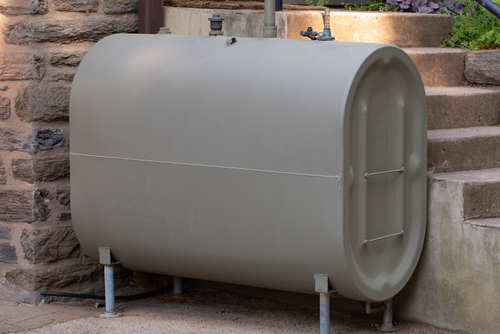

Middle Village is a settled, tightly held neighborhood where houses tend to stay in families and nobody moves much. That has a direct bearing on oil tanks: a house that has not changed hands in forty years has often not had its heating equipment seriously reviewed in forty years either. Domino's Oil Tank Service has been replacing tanks here since 1980, and our shop in Woodside is a short run up Woodhaven Boulevard.
- Free same-day estimates throughout Middle Village 11379
- Experience with shared driveways and semi-attached brick homes
- Tanks from $3,200 installed, old tank removal and disposal included
- Licensed and insured, working in Queens for forty-five years
- 24-hour emergency response for active leaks
Oil tank replacement in Middle Village. Free estimate, firm price, and most jobs done the same day.
Call (718) 989-2105 ➤Semi-Attached Brick, Shared Driveways, and Long-Held Houses
The semi-attached brick homes around Juniper Valley Park, along the streets off Juniper Boulevard and toward Eliot Avenue, are the classic Middle Village house: solidly built, generally 1920s and 1930s, attached on one side, with a driveway running down the other. Full basements with decent headroom. From a tank standpoint they are comfortable to work in — the driveway gets a truck close, and there is often a side or rear basement entrance.
The shared driveway is the local wrinkle. A great many Middle Village houses share a single drive between two properties, and on installation day we need it for a few hours. It is never actually a problem, but it is worth telling your neighbour in advance rather than having the conversation while a truck is already sitting there.
The blocks along Metropolitan Avenue and toward Glendale mix in more attached housing and some frame construction, where access narrows and the tank options narrow with it.
The thing we most often find in Middle Village is simply age. These are houses people hold on to, passed down within families, and the heating system frequently gets attention only when something goes wrong. We regularly replace tanks here that are original to a 1930s house — ninety years in service, sitting in a dry basement, looking not particularly alarming from the outside. If you have owned your house a long time and cannot remember replacing the tank, you probably have not.
When to Act
The corrosion happens inside, under the oil, where condensed water settles and works through the steel. The outside of a tank tells you very little. Signs worth acting on:
- A delivery company that has refused to fill you or put you on notice
- Any tank you inherited with the house and cannot put an age to
- Weeping, seeping, or a dark ring on the floor around the tank base
- Flaking rust or scale collecting under the legs and the bottom weld
- A heating oil smell that hangs in the basement and will not clear
- Visible swelling, denting, or soft spots in the shell
Age is the honest test in Middle Village. A tank you have never replaced in a house built before 1940 is not a maybe. If oil is already visible, our emergency leaking tank page covers the immediate steps.
Tank Options Here
- Granby Standard 275 gallon — $3,200 installed. Single-wall steel and the most economical option, well suited to a dry basement with workable access.
- Granby EcoGuard — $3,890 installed. Double-wall steel with a containment layer that catches an inner-tank breach before it reaches your floor.
- Roth double-wall — $3,990 installed. A polyethylene inner tank that cannot rust, a galvanized outer shell, and a $1 million environmental insurance policy included.
Most Middle Village houses give you a genuine choice, because access via the driveway and a side entrance is usually workable and the basements have headroom. That means the decision is about protection rather than geometry. Our view, given how long people stay in these houses: if you are replacing a tank that has lasted since the 1930s, you are buying for the next several decades, and a double-wall tank removes rust-through from the equation entirely.
What the Job Involves
- Step one: the estimate. Free, no obligation, and usually available the same day you call. You get a firm price before anything is touched.
- Step two: the old tank comes out. Oil pumped and preserved, tank removed and disposed of properly. Cut down on site if there is no way to get it out intact.
- Step three: the new tank goes in. Set level on a proper base, piped into your existing system, fill and vent lines replaced where needed, new filter and shutoff valve.
- Step four: testing. The burner is fired and every connection checked under pressure before we pack up. Your oil goes back in the new tank and the basement gets cleaned. Three to four hours, typically.
Where We Work in Middle Village
All of 11379 — the streets around Juniper Valley Park and Juniper Boulevard, the Metropolitan Avenue and Eliot Avenue corridors, the blocks near St. John Cemetery, and the areas running toward Glendale, Maspeth and Rego Park. We also serve neighboring Glendale, Maspeth, and Ridgewood.
More about our team, or the full borough on our Queens service areas page.
Frequently Asked Questions
We share a driveway with our neighbour. Is that going to be an issue?
Not really, but give your neighbour some notice. We need the drive for a few hours on installation day. A quick heads-up beforehand avoids the conversation happening while our truck is already parked in it.
Our house has been in the family since the 1930s and I do not think the tank was ever changed. Possible?
Entirely possible, and we see it regularly in Middle Village. These houses stay in families and the heating system often gets attention only when something fails. A tank that old should be replaced regardless of how sound it looks.
How much does it cost in Middle Village?
$3,200 installed for the Granby Standard 275 gallon, $3,890 for the Granby EcoGuard, and $3,990 for the Roth double-wall, each including removal and disposal of your old tank and a full system test.
Is access usually good here?
In the semi-attached brick homes around Juniper Valley, yes — a driveway down one side, a full basement, and often a side or rear entrance. The blocks toward Metropolitan Avenue and Glendale include more attached and frame housing where access is tighter.
Which tank would you recommend?
In a house you plan to keep, a double-wall one. If your current tank lasted since the 1930s, the replacement is likely to be the last one you buy, and paying a few hundred more to eliminate rust-through as a failure mode is sensible over that timescale.
How long does it take?
Three to four hours for a typical Middle Village house, including draining and removing the old tank.
Do you offer emergency service?
Yes, 24 hours a day for active leaks. Call (718) 989-2105. Keep the area ventilated, keep people and pets away, and do not try to move or patch the tank.
More questions about tank sizing, permits, and what affects the final price are answered on our oil tank FAQ page.
Ready to replace your Middle Village oil tank? Call for a free estimate anywhere in Middle Village.
Get Your Free Estimate ➤