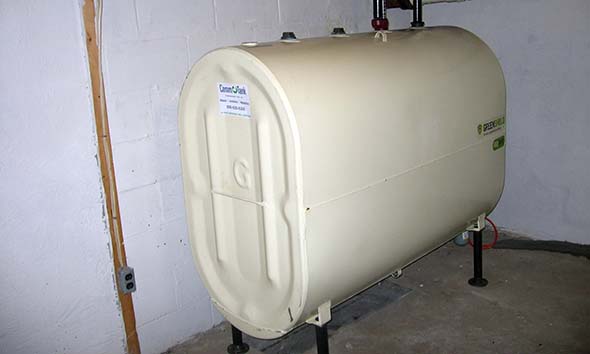

College Point is its own peninsula, tucked between Flushing Bay and the East River, and it has some of the oldest housing anywhere in Queens. A neighborhood built up around Conrad Poppenhusen's rubber works in the 1850s and 1860s still has the frame houses to show for it — and in a fair number of them, a heating oil tank that has been in the cellar far longer than anyone currently living there. Domino's Oil Tank Service has been replacing those tanks since 1980.
- Free same-day estimates throughout College Point 11356
- Experience with 19th century frame houses and awkward old cellars
- Tanks from $3,200 installed, old tank removal and disposal included
- Licensed and insured, forty-five years working in Queens
- 24-hour emergency response for active leaks
Oil tank replacement in College Point. Free estimate, firm pricing, most jobs finished in a single visit.
Call (718) 989-2105 ➤Working on College Point's Older Housing Stock
The old village core, on the streets around the Poppenhusen Institute and running down toward the water, is where the genuinely old houses are. Wood-frame, narrow, built close together, often with cellars that were dug rather than poured and ceilings that were never meant for anyone over six feet. These homes present three related problems: getting a tank down the stairs, having room to turn it once you are down there, and finding solid, level ground to set it on. Old cellars frequently have uneven or partially dirt floors, and a 275 gallon tank holds well over a ton of oil when full. It needs a proper base, and in these houses that sometimes means pouring one before the tank goes in.
The residential grid east of College Point Boulevard, through the numbered streets and avenues, is more conventional: 20th century detached and semi-detached homes, driveways, better basements. These replace easily.
The waterfront edges near MacNeil Park and along the northern shore put houses close to the water, and the low-lying blocks near Flushing Bay have seen tidal flooding. If your basement has ever taken water, that is directly relevant to your tank. A tank sitting in a cellar that floods periodically corrodes from the outside as well as the inside, and a tank that is not properly secured can shift or float in a serious flood, tearing the fill and supply lines away from it. We check anchoring on any job in a flood-prone block.
The industrial strip along the Flushing Bay side is a different matter again, with commercial equipment rather than residential tanks.
Knowing When It Is Time
Oil tanks corrode from the inside. Water condenses in the airspace, settles under the oil where it cannot evaporate, and works through the steel floor of the tank. That is why age matters more than appearance. Signs to act on:
- A delivery company that has refused to fill you or put you on notice
- Any tank you inherited with the house and cannot put an age to
- Weeping, seeping, or a dark ring on the floor around the tank base
- Flaking rust or scale collecting under the legs and the bottom weld
- A heating oil smell that hangs in the basement and will not clear
- Visible swelling, denting, or soft spots in the shell
In a house with a dirt or partially finished cellar floor, a leak soaks straight into the ground rather than pooling where you would see it — which is exactly why old-house tanks tend to be discovered late. If you smell oil at all, get it checked. Our emergency leaking tank page covers what to do right now.
Choosing a Tank for a College Point Cellar
- Granby Standard 275 gallon at $3,200 installed. The straightforward single-wall steel tank. If your cellar is dry and the route in is clear, it does the job without paying for protection you may not need.
- Granby EcoGuard at $3,890 installed. Steel construction with a second wall around it, so if the inner tank ever gives way the oil is contained instead of ending up on your floor.
- Roth double-wall at $3,990 installed. The inner tank is blow-molded polyethylene, so rust is simply not a failure mode. Comes with a $1 million environmental insurance policy at no extra cost.
Headroom is the deciding factor in the old village houses. The Roth is vertical and needs clearance that a low 19th century cellar may not have, in which case a horizontal Granby is what physically fits. Where there is room, the Roth is a strong choice here for a different reason: these older cellars tend to be damp, and a polyethylene inner tank does not care about moisture the way steel does. If your basement has ever flooded, we would steer you to a double-wall tank and make sure it is properly anchored.
How the Work Goes
- You call, we assess. A description of the tank and the way down to it is usually enough for a firm number. When it is not, the site visit is free and normally same day.
- Drain and remove. We pump the oil, keep what is usable, and take the old tank out. Where the stairs or the doorway will not allow it, the tank is cut down where it stands and carried out in sections.
- Install and connect. The new tank goes onto a proper base and is tied into your oil lines and burner, with fill and vent piping renewed where it needs to be and a new filter and shutoff fitted.
- Fire, check, tidy. We run the burner, pressure-test every joint, put your oil back, and leave the space as we found it. Most jobs take three to four hours.
Where We Work in College Point
All of 11356 — the old village streets near the Poppenhusen Institute, the residential grid east of College Point Boulevard, the blocks around MacNeil Park and the northern waterfront, and the area toward the Whitestone Expressway. Neighboring Whitestone and Flushing are covered as well.
More about our company, or the whole borough on our Queens service areas page.
Frequently Asked Questions
My College Point house is from the 1800s. Can you work in a cellar that old?
Yes, and we do regularly. The usual constraints are headroom, stair width, and floor condition. Old cellars are often uneven or partly dirt, and a full 275 gallon tank weighs well over a ton, so it needs a solid level base. Sometimes that means pouring one as part of the job, which we would tell you at the estimate rather than on the day.
My basement has flooded before. Does that affect the tank?
Significantly. A tank in a cellar that takes water corrodes from the outside as well as the inside, and an inadequately secured tank can shift or float in a serious flood and pull its lines apart. We check anchoring on every job in a flood-prone block and would recommend a double-wall tank.
What does it cost in College Point?
$3,200 installed for the Granby Standard, $3,890 for the Granby EcoGuard, $3,990 for the Roth, each including removal and disposal of the old tank. If a new base has to be poured or access is unusually tight, that is reflected in the estimate up front.
My cellar ceiling is very low. What are my options?
A horizontal Granby, most likely. The Roth is a vertical tank and needs headroom that many of the old village houses simply do not have. We measure before recommending, because a tank that fits through the door but not under the joists helps nobody.
There is a dirt floor under my tank. Is that a problem?
It is a reason to act sooner rather than later. On a dirt floor a leak soaks into the ground instead of pooling visibly, so problems get found late and cleanups get bigger. It also means the new tank will need a proper base.
How long does the job take?
Three to four hours for a straightforward replacement. Older houses with tight access or a base that needs pouring take longer, and we will tell you which one yours is before we start.
Do you cover the whole peninsula?
Yes, all of 11356, from the old village core down to the waterfront and across to the Whitestone Expressway side.
More questions about tank sizing, permits, and what affects the final price are answered on our oil tank FAQ page.
Ready to replace your College Point oil tank? Call for a free estimate anywhere in 11356.
Get Your Free Estimate ➤