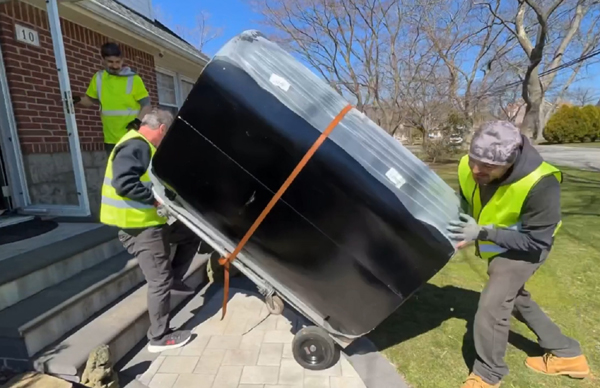

St. Albans is a neighborhood of substantial detached houses — Tudors, colonials and Dutch colonials, largely built in the 1920s and 1930s, on proper lots with driveways and full basements. Domino's Oil Tank Service has been replacing oil tanks in these homes since 1980, and they are among the more satisfying jobs we do, because the houses give us room to work properly.
- Free same-day estimates throughout St. Albans 11412
- Experience with Addisleigh Park properties and 1920s Tudor construction
- Tanks from $3,200 installed, old tank removal and disposal included
- Licensed and insured, forty-five years serving Queens
- 24-hour emergency response for active leaks
Oil tank replacement in St. Albans. Free estimate, honest pricing, most jobs completed in one visit.
Call (718) 989-2105 ➤Addisleigh Park and the Wider Neighborhood
Addisleigh Park, the section around Sayres Avenue, Adelaide Road and the surrounding streets, is a designated New York City historic district. It is architecturally distinguished — English Tudor and colonial revival houses on landscaped lots — and historically significant as the home of a remarkable number of Black musicians, athletes and public figures during the mid-twentieth century. If you own here, the practical question about historic district status is narrow: it governs alterations to the exterior of the building and what is visible from the street. A tank inside your basement is unaffected. It can matter if a job would put new fill or vent piping on a visible facade, and we raise that at the estimate when it applies rather than afterward.
The houses themselves are a pleasure to work in. Full-height basements, decent stairs, driveways, and frequently a side or rear basement entrance. The constraint, when there is one, is that these homes have often been renovated over ninety years and the utility area may have been built around at some point.
The wider neighborhood, running toward Linden Boulevard, Merrick Boulevard and Farmers Boulevard, is similar detached and semi-detached single-family housing from the same era, with the same profile: good access, roomy basements, and a lot of tanks that have been in place a very long time.
These are 1920s and 1930s houses that were built for coal and converted to oil. As with Richmond Hill, we periodically find conversion-era equipment still in service — unusual sizes, brick plinths, no legible data plate. That is a tank at the end of a very long life.
Recognizing a Failing Tank
The corrosion is internal, under the oil, on the floor of the tank where nothing is visible. Signs to act on:
- Staining, damp patches, or an oily sheen on the floor under the tank
- Rust at the bottom seam, on the legs, or around the fill and vent lines
- An oil smell in the basement that lingers, strongest after a delivery
- Pitting, denting, or bulging anywhere on the tank shell
- A tank over 20 years old, or one you cannot date
- A fuel supplier who has flagged the tank or stopped filling it
If your tank might date to the original coal-to-oil conversion, the symptom list is beside the point — age settles it. Oil visible now? Read emergency leaking tank replacement and call.
Tank Options in St. Albans
- Granby Standard 275 gallon at $3,200 installed. The straightforward single-wall steel tank. If your cellar is dry and the route in is clear, it does the job without paying for protection you may not need.
- Granby EcoGuard at $3,890 installed. Steel construction with a second wall around it, so if the inner tank ever gives way the oil is contained instead of ending up on your floor.
- Roth double-wall at $3,990 installed. The inner tank is blow-molded polyethylene, so rust is simply not a failure mode. Comes with a $1 million environmental insurance policy at no extra cost.
Access is seldom the limiting factor in these houses, so the choice is genuinely yours. Two considerations push toward double-wall here: many of these basements have been finished or partly finished over the decades, and a release into finished space is a far more expensive event than one onto bare concrete; and if you are replacing conversion-era equipment, you are buying a tank that will likely outlast your ownership of the house, which is worth doing once and properly.
The Process
- Step one: the estimate. Free, no obligation, and usually available the same day you call. You get a firm price before anything is touched.
- Step two: the old tank comes out. Oil pumped and preserved, tank removed and disposed of properly. Cut down on site if there is no way to get it out intact.
- Step three: the new tank goes in. Set level on a proper base, piped into your existing system, fill and vent lines replaced where needed, new filter and shutoff valve.
- Step four: testing. The burner is fired and every connection checked under pressure before we pack up. Your oil goes back in the new tank and the basement gets cleaned. Three to four hours, typically.
Where We Work in St. Albans
All of 11412 — Addisleigh Park, the streets around Linden Boulevard, Merrick Boulevard and Farmers Boulevard, and the blocks running toward Hollis, Springfield Gardens and Cambria Heights. Neighboring Cambria Heights, Queens Village, and Jamaica are covered as well.
More about our crew, or see the whole borough on our Queens service areas page.
Frequently Asked Questions
Does Addisleigh Park historic district status affect replacing my tank?
Not for a tank inside your basement. The designation governs exterior alterations and what is visible from the street, so interior equipment falls outside it. It can become relevant if work would put new fill or vent piping on a visible facade, and we will raise that before starting.
What does oil tank replacement cost in St. Albans?
$3,200 installed for the Granby Standard, $3,890 for the Granby EcoGuard, and $3,990 for the Roth, each including the tank, labor, removal and disposal of the old tank, and a full system test.
Is access usually good in these houses?
Yes. St. Albans homes tend to have driveways, full-height basements, decent stairs and often a side or rear basement entrance. The occasional complication is a utility area that has been built around during a past renovation.
My tank sits on a brick base and has no label. What does that tell you?
That it is very likely original to the house's coal-to-oil conversion, which in 1920s and 1930s St. Albans housing would make it extremely old. Age alone is sufficient reason to replace it.
Our basement is finished. Which tank should we get?
A double-wall one. The containment layer is what stops an inner tank failure from becoming a flooring and drywall problem. The cost difference is a few hundred dollars against a repair bill that is considerably more.
How long does the job take?
Three to four hours for a standard replacement. An oversized conversion-era tank that needs cutting down in place takes longer, and we would tell you that up front.
Do you offer emergency service?
Yes, 24 hours for active leaks. Call (718) 989-2105. Ventilate the area, keep people and pets away, and do not attempt to move or patch the tank.
More questions about tank sizing, permits, and what affects the final price are answered on our oil tank FAQ page.
Ready to replace your St. Albans oil tank? Call for a free estimate anywhere in St. Albans.
Get Your Free Estimate ➤